
Electronic PriorAuthorization Softwarefor Connected Care
Manage prior authorizations alongside patient, clinical, insurance, and revenue workflows—all in one Salesforce-native platform.

From Clinical Need to Authorized Care
One connected path across the Elixir platform.
Clinical Need
A provider orders a service during the care episode.
Electronic Prior Authorization
The request is built from existing patient, insurance and clinical data.
Payer
Submitted through the configured payer or clearinghouse channel.
Authorization Decision
Decisions recorded per service, with numbers, dates and approved units.
Care & RCM
Approved services flow into scheduling, documentation and billing.
AI-Powered Prior Authorization
Elixir's AI Co-Pilot surfaces guidance at each stage of the authorization lifecycle. Every insight is assistive - reviewers confirm before anything is submitted.
Before Submission
- Medical necessity assessment
- Authorization readiness scoring
- Missing documentation detection
- CPT-diagnosis validation
- Payer policy review
Prevent denials
During Submission
- Clinical narrative generation
- Prior authorization letter generation
- Supporting document selection
- Submission quality review
Assisted drafting
After Submission
- Decision prediction
- Turnaround prediction
- Additional information request support
Tracking
Denial Intelligence
- Denial prediction
- Root cause analysis
- Appeal recommendation
- Appeal letter generation
Recovery
Capability availability varies by release. Roadmap items are marked and confirmed during scoping.
Prior authorization works better when it shares data with the rest of the record

Service-Level Control
Each requested service carries its own decision, authorization number, dates and approved units, so a partially approved request stays accurate rather than being flattened into one status.

Bulk EDI 270/271
Select insurance records and use Generate Bulk EDI 270 to send eligibility requests for many patients in one action.
Standard product feature

Automated batch verification
Schedule real-time checks for upcoming appointments or your active patient list, so coverage is confirmed before the day starts.
Configured for your organization
The Electronic Prior Authorization Workflow
Each step happens inside Elixir, against the same patient and care episode record.
Step 1
Identify Need
Authorization requirement flagged during the clinical workflow.
Step 2
Create Authorization
Start from the care episode or utilization review: parent data carries over.
Step 3
Select Services
Choose procedures from the patient's ordered services; add units and dates.
Step 4
Add Documentation
Attach clinical evidence and medical necessity as Salesforce Files.
Step 5
Review
Validate completeness before anything leaves the organization.
Step 6
Submit
Send through the configured payer, portal, fax or clearinghouse channel.
Step 7
Track Payer Response
Monitor status and manage additional information requests.
Step 8
Record Decision
Capture the outcome per service with numbers, dates and restrictions.
Step 9
Monitor Authorization
Track used and remaining units against the approval window.
Step 10
Appeal if Needed
Create an appeal from denied or partially approved services.
Prior Authorization Management
Prior Authorization Management Software Built Around the Request
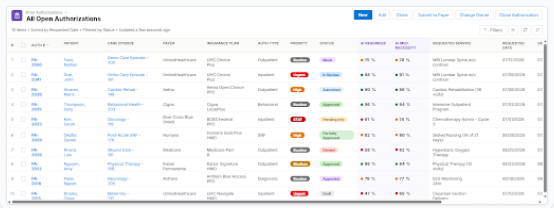
Create authorization requests directly from clinical workflows, with the patient, care episode, insurance and payer already attached. Capture everything a payer asks for without leaving the record.
 Initiate authorization from the care episode or utilization review
- Capture CPT and procedure information, requested units, service dates and place of service
- Record clinical information, medical necessity and supporting documentation
- Track submission, payer follow-up and additional information requests
- Manage denied and partially approved services, then initiate appeals
Authorization Decisions
Service-Level Authorization Decisions
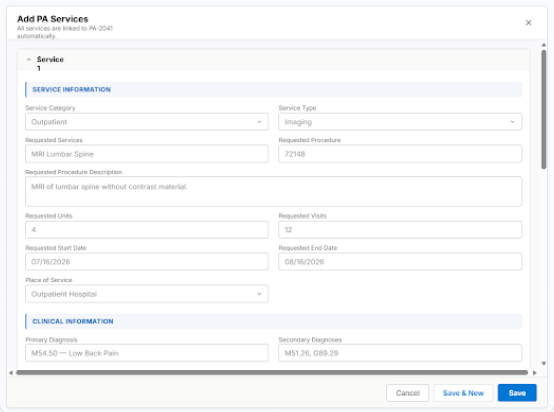
A single authorization can contain several requested services, and payers rarely treat them identically. Elixir records the decision against each service so teams can see exactly what was approved.
- Pending, Approved, Partially Approved and Denied tracked per service
- Authorization number, start date and end date held at the service level
- Approved units, restrictions, decision date and approval notes captured individually
- Used and remaining units visible against each approved service
Salesforce-Native Healthcare Platform
Salesforce-Native Electronic Prior Authorization
Elixir is built natively on Salesforce, so prior authorization uses the same platform, security model and data as the rest of your healthcare operation. Configuration happens through Salesforce tooling rather than custom code.
- Lightning-based record pages, list views and related lists
- Shared healthcare data across EHR, utilization management and RCM
- Configurable page layouts, picklists, validation and automation
- Less context switching between clinical and authorization systems
- Connected authorization and financial workflows
Payer & Clearinghouse Integration
Electronic Prior Authorization with Payer and Clearinghouse Integration
Submit authorization requests and receive determinations electronically via standard EDI 278 transactions, payer portal integrations, or clearinghouse gateways.
- Direct electronic 278/279 submission and receipt loops
- Portal bridge for payers requiring proprietary web submission
- Real-time status inquiry and automatic logging of responses
EDI 278 Flow
Elixir builds the 278 request
Patient, member ID, provider, CPT, units and dates taken from the Prior Authorization.
Clearinghouse parses 279 response
Automated ingest updates authorization status, reference number and service lines directly.
Utilization Management
Prior Authorization and Utilization Management Software Together
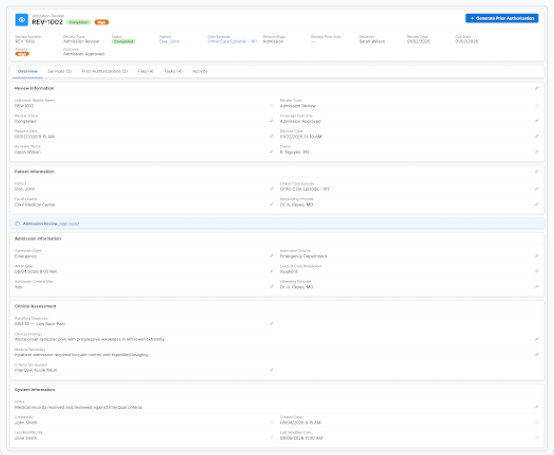
Utilization reviews and authorizations describe the same episode of care. In Elixir they share services and documentation, so a review can generate the authorization it justifies.
- Admission, concurrent and retrospective utilization reviews
- Service-level review with requested and approved units
- Coverage outcomes and authorization information recorded on the review
- Generate a prior authorization from a review, carrying the selected services
- Authorization lifecycle tracked from review through decision
Clinical Documentation
Supporting Documentation That Stays With the Authorization
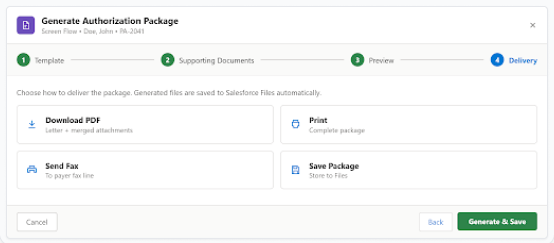
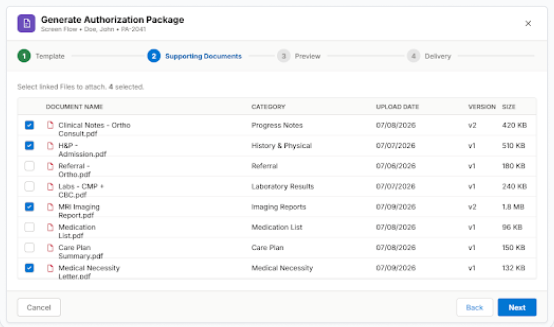
Clinical evidence is what payers actually evaluate. Elixir keeps it attached to the authorization it supports, using standard Salesforce Files.
- Clinical records, provider documentation and supporting evidence in one place
- Standard Salesforce Files; upload, preview, download, share and version
- Documentation linked to the specific authorization or appeal
- Select which documents accompany a submission package
Appeals
Prior Authorization Appeal Software
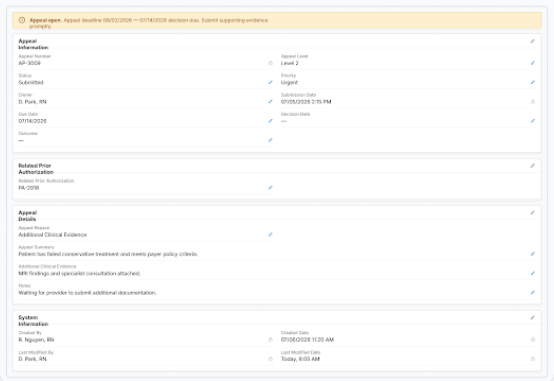
When a payer denies or partially approves a request, the appeal starts from the authorization itself, carrying the denial detail and the services in dispute.
- Create an appeal directly from a prior authorization
- Select the specific denied or partially approved services to appeal
- Relationship between authorization and appeal maintained throughout
- Appeal documentation, correspondence and decisions managed on the record
- Multiple appeal levels supported where the payer allows them
Benefits of Prior Authorization Automation
What teams gain when authorization stops living in a separate system.
- Centralized authorization information across the organization
- Less manual administrative and re-keying work
- Clinical and authorization workflows in one system
- Clearer visibility into where each request stands
- Service-level authorization tracking, not just request-level
- Reduced duplicate data entry between systems
- Documentation connected to the request it supports
- Utilization management connected to authorization
- Appeals connected to the original decision
- Authorization data available to downstream RCM workflows
Who Uses Electronic Prior Authorization Software?
Elixir suits clinical organizations where authorization volume, payer variety or multi-site coordination makes manual tracking costly.
Behavioral Health Organizations
Recurring authorizations, unit-based approvals and frequent continued-stay reviews across long treatment episodes.
Specialty Clinics
High-cost imaging, procedures and therapies where medical necessity documentation drives the decision.
Medical Groups
Many providers and payers, with authorization work spread across clinical and administrative staff.
Ambulatory Care Organizations
Scheduled procedures where authorization timing directly affects whether care can proceed.
Multi-Location Organizations
Shared authorization queues and consistent workflow across sites and service lines.
Healthcare Billing Organizations
Teams managing authorization on behalf of providers, needing an auditable trail per request.
Complex Payer Environments
Organizations working across many payer rules, portals and submission channels at once.
Why Elixir for Electronic Prior Authorization?
EHR, prior authorization, utilization management, RCM and patient engagement run on one Salesforce-native healthcare platform, against shared data.
EHR
Patient, care episode, encounters and clinical documentation.
Prior Authorization
Requests, services, submissions, decisions and appeals.
Utilization Management
Admission, concurrent and retrospective reviews.
Revenue Cycle Management
Claims, remits, payments and patient statements.
Patient Engagement
Communication and coordination across the episode.
Ready to change how you handle prior authorization?