
 Verify Coverage (270)
CMS-1500 Professional Claims
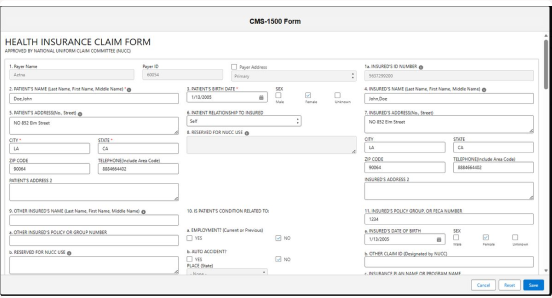
Generate and review professional claims on the NUCC-approved CMS-1500 layout,populated from patient, subscriber, provider and procedure data in Elixir. Corresponds to the 837P transaction.
Unified, native clinical-financial synchronization delivering end-to-end adjudication transparency and automated payer reconciliation.

Unified RCM Platform
Revenue cycle problems are rarely billing problems. They start upstream, with an unverified plan, a missing authorization, or a code the payer will not accept, and surface weeks later as a denial.
Elixir brings eligibility verification, payer workflows, medical claims management, clearinghouse transactions, ERA payment posting, denials and patient billing into the same healthcare platform your clinical and front-office teams already work in. Built natively on Salesforce, Elixir keeps clinical, payer and financial activity on one record, so the information that determines whether a claim gets paid is captured where the work actually happens.

Sixteen connected stages, from patient registration to reconciliation, on one platform rather than across disconnected applications.
 Upstream Verification
Eligibility is the first financial checkpoint in the revenue cycle, and the cheapest place to catch a problem. Elixir supports insurance eligibility verification through 270 eligibility inquiry and 271 response transactions exchanged with supported payers and clearinghouse connections, so staff can confirm coverage before a patient is seen rather than after a claim is denied.
 Coverage status, plan and payer identification from the 271 responseBenefit detail including copay, coinsurance and deductible information returned by the payerCoverage effective and termination dates, with the last verified date on the recordVerification status and coverage status shown separately, so a plan that verified but has since lapsed is visibleEligibility history retained for audit and follow-up
Results are stored against the patient and the insurance record, which means the front desk, the clinical team and the billing team are all reading the same answer.

 Rules Automation
Every payer has its own rules, forms, timelines and tolerances. Payer workflow management in Elixir means payer-specific requirements are configured into the work rather than carried in a spreadsheet or in someone's head, and that every payer interaction stays attached to the patient, the claim and the money.
Payers, payer IDs, plans and subscriber detail maintained as records that claims read fromPrior authorization numbers, covered services, units and validity dates tracked and surfaced at claim validationPayer-specific rules applied when the claim is built, including timely filing windows and NDC reportingSubmission, acknowledgement, rejection, payment and denial tracked against the claimAdjudication detail returned to the claim at claim and line levelElixir produces both claim types from the same patient and encounter data, so professional and institutional billing run on one record set.
Generate and review professional claims on the NUCC-approved CMS-1500 layout,populated from patient, subscriber, provider and procedure data in Elixir. Corresponds to the 837P transaction.
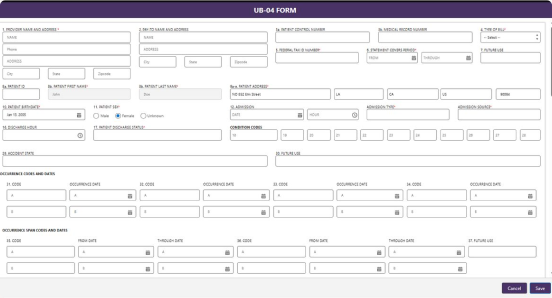
Support institutional billing on the UB-04 layout, including type of bill, statement covers period, condition codes, and occurrence codes and dates. Corresponds to the837I transaction.
 Clean Claims Engine
Elixir's medical claims management software builds claims from the patient, coverage, provider and encounter data already held in the platform, then validates them against the rules that decide whether a payer will accept them.
Validation runs before submission and returns errors at the field the biller has to fix, on the claim and on the individual claim line.
Claim and claim-line validation with the specific reason shown beside the fieldCoding edits including NCCI bundling relationships and Medically Unlikely Edit unit limitsModifier requirements when procedures are billed together on the same date of serviceMedical necessity checks against local coverage determination policyTimely filing awareness, including how much of the payer's window remainsCorrections, replacements and resubmission with history retained on the record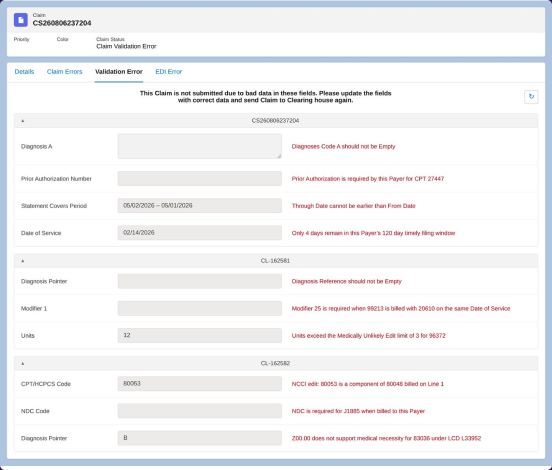
 Clearinghouse EDI
Connect Elixir to supported clearinghouse workflows to exchange eligibility, claims, remittance and claim-status transactions without forcing revenue cycle teams to manage disconnected systems. EDI transactions are staged, tracked and reconciled inside the platform, and responses come back to the claim they belong to.
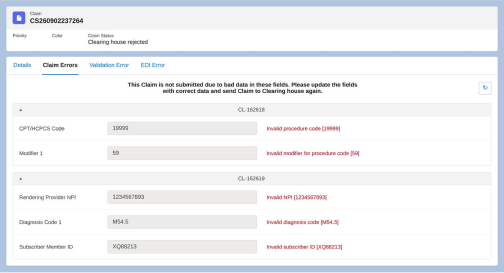
When a clearinghouse rejects a claim, the rejection is written back to the claim record with the offending field and the message beside it: an invalid procedure code, an invalid modifier, an NPI that does not validate, a diagnosis code the payer will not accept, a subscriber ID that does not match. Claim errors, validation errors and EDI errors are kept separate, so teams can tell a data problem Elixir caught from one the clearinghouse caught.
| Transaction | What it does | Where it appears in Elixir |
|---|---|---|
| 270 | Eligibility and benefit inquiry sent to the payer | Eligibility verification from the patient insurance record |
| 271 | Eligibility and benefit response returned by the payer | Coverage, benefits and eligibility history on the patient |
| 837P | Professional claim submission | CMS-1500 claims created and validated in Elixir |
| 837I | Institutional claim submission | UB-04 claims created and validated in Elixir |
| 276 | Claim status inquiry | Claim status follow-up on the claim record |
| 277 | Claim status response and acknowledgement | Claim status, acknowledgement and rejection detail |
| 835 | Electronic remittance advice | ERA ingestion, matching and payment posting |
An 835 ERA tells you what the payer decided and what it paid. Elixir ingests the file, matches it to the claims it covers and turns it into a posting worklist, so teams are reconciling rather than re-typing.
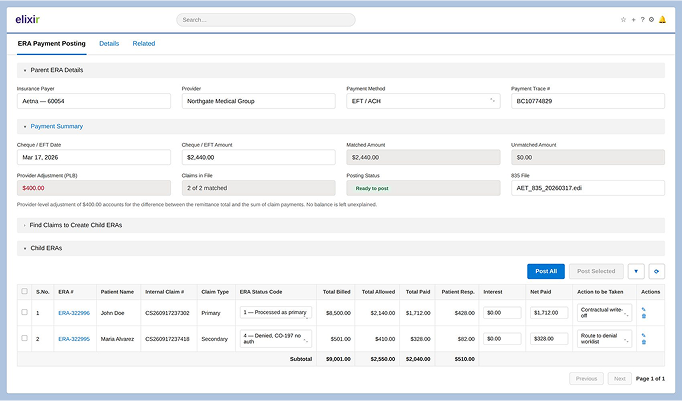

The 835 is processed into a parent ERA with payer, provider, payment method, payment trace number and EFT date, then matched against the claims it references. Matched and unmatched amounts are shown so nothing posts against an unexplained balance.

Each child ERA carries the claim, claim type, ERA status code, total billed, total allowed, total paid, patient responsibility, interest and net paid.

Provider-level adjustments (PLB) are accounted for against the remittance total, so the difference between the payment and the sum of claim payments is explained rather than written off blind.

Post all lines or post selected lines, and set the action each line requires: contractual write-off, patient responsibility, or route to the denial worklist.
 Active Resolution
A denial is only workable if the person working it can see why it happened. In Elixir, denials arrive through the remittance with the payer's reason code attached, and stay connected to the claim, the claim line, the encounter, the payer and the patient balance they affect.
Identification: denied lines flagged as the ERA is processed and routed to a denial worklist during posting, rather than discovered in a later A/R reviewReason and context: the reason code sits with the claim line, the procedure, the diagnosis, the authorization on file and the eligibility response captured before the visitFinancial impact: billed, allowed, paid and patient responsibility make the value of each denial visible at the line that caused itCorrective action: correct the data, produce a corrected or replacement claim and resubmit, with the original claim, the denial and the correction retained in history
Some denials are corrections. Others are disagreements, and they need an appeal. Elixir keeps the evidence in one place: the claim as submitted, the payer's adjudication, the clinical documentation from the encounter, the authorization on file and the eligibility response captured at intake.
Work denied claims from the denial worklist and separate the ones that need data correction from theones that need to be argued.
Pull the documentation, coding and coverage detail already connected to the claim instead of rebuildingthe case from separate systems, and draft the appealletter from that context.
Record appeal activity, dates and outcomes against the claim and payer so follow-up and timely filing deadlines stay visible.
Appeal submission methods vary by payer and by plan. Electronic appeal submission is available only where the payer supports it and where the connection has been implemented for your organization.
Elixir is built natively on Salesforce. For an organization evaluating Salesforce revenue cycle management, that architecture decision has practical consequences for how the system is configured, secured, reported on and extended.
Patients, coverage, providers, encounters, claims, remittances and payments are records in the same platform, related to each other rather than synchronized between products.
Page layouts, fields, list views, validation and automation are configured to the way your revenue cycle team works, not the other way round.
Salesforce profiles, permission sets and sharing rules govern who can see and do what across clinical, billing and payer data.
Salesforce reports and dashboards run on the same records your teams work in, so operational reporting does not require a separate extract.
Salesforce APIs and integration patterns are available for connecting Elixir to the other systems in your environment, scoped during implementation.
Elixir inherits the infrastructure and security architecture of the Salesforce platform. Compliance obligations remain a shared responsibility, addressed in your implementation and agreements.
Elixir is an independently developed application built on the Salesforce platform. Elixir is not a Salesforce product, and nothing here should be read as a Salesforce endorsement or certification of Elixir. Salesforce platform capabilities described above are capabilities of the underlying platform and are distinct from Elixir functionality.
An EHR records care. An RCM system gets that care paid for. They are different jobs, but they run on the same facts, and when they run on different systems, those facts stop agreeing with each other.
 What separation costs
 The connected model
In Elixir, documentation, coding, charges, claims, remittance and payment are stages of one record rather than handoffs between products. Clinical documentation supports the codes. The codes build the claim. The claim carries the coverage verified at intake and the authorization recorded before the visit. The remittance posts back against the claim it paid, and what the patient owes is calculated from what the payer actually allowed.
That is the difference between integrated EHR and RCM software and a billing system with an interface bolted to it.
The revenue cycle is the same shape everywhere, but the pressure points differ. These are the patterns Elixir is configured around.

Intake and coverage capture, authorization tracking against approved units, recurring service documentation, claim generation fromencounters, and denial follow-up where authorization and medical necessity are the common causes.

Eligibility before the visit, coding tied to documentation, professional claims on CMS-1500, ERA posting, and patient statements calculated from the payer's allowed amount.

Multiple programs and funding sources against one patient record, insurance where it exists, and claims,payments and patient financial workflows kept distinct per program.

Multiple client providers, multiple billing NPIs and multiple payer mixes in one platform, with claims, clearinghouse transactions, ERA posting and denial management separated by client.
Growth usually means more payers, more provider numbers and more service locations, and more ways for a claim to be built incorrectly. Elixir is structured so those variables are configuration rather than exceptions.
Multiple payers and plans with their own identifiers and requirements, and primary, secondary and
subsequent coverage on the same patientMultiple providers and NPIs across rendering, billing and pay-to relationships, and multiple tax
identification numbersMultiple service locations, with encounters and claims associated to the correct location and place of
servicePayer-specific requirements configured so the rules follow the claim instead of relying on institutional
memory
Connected workflows matter differently depending on which part of the cycle you own.
Operational reporting on live records across eligibility, claims, remittance and denials.
Visibility into where claims are stalling, and the ability to configure the rules that stop them stalling again.
Coverage and benefit verification recorded where clinical and billing teams can both see it.
Claims built from existing data, with errors surfaced at the field rather than after rejection.
Validation, clearinghouse and EDI errors separated, with correction and resubmission on the same record.
Matched remittance, provider-level adjustments accounted for, and posting actions per line.
Denial reason, claim line, payer and financial impact together in one worklist.
Documentation and coding in the same place, with coverage and authorization context visible.
Patient balance, insurance status and claim history answerable from the patient record.
 Predictive Intelligence
Elixir scores financial risk, predicts denials and payment timing, and works up denied claims. Every output is a recommendation with its reasoning shown, so the person working the account decides what happens next.
An account-level financial risk score from 0 to 100 with a High, Medium or Low band, shown in the patient header before any claim is opened. It weighs unpaid claim count and value, balance trend, denial rate against peer benchmarks and days in A/R, and is accompanied by a collections propensity.
A denial likelihood from 0 to 100 on every claim, shown as a colour-banded pill in the claims table and on the claims list. It indicates which claims are likely to be denied rather than simply which are unpaid, so a submission batch can be triaged at a glance.
The expected payment window for a claim, expressed as a day range rather than a single date. The midpoint is the expected payment day and the width of the range reflects confidence, so a low-risk claim with a narrow window can be relied on for cash-flow planning and a high-risk claim with a wide one is worked instead of forecast.
Classifies a denied claim as missing authorization, coding error, eligibility, medical necessity, timely filing or duplicate claim, with the reasoning for that call, the likely ANSI claim adjustment reason codes and a confidence level. Three prioritised next steps follow, each marked by how soon to act.
Scores the likelihood an appeal succeeds and returns a recommendation: appeal, resubmit, write off or contact the payer. The driving factors are shown alongside it, including payer behaviour, denial type, provider match and the days left in the filing window. A low score is the evidence for a write-off decision.
Generates an editable appeal letter for a denied claim from the claim, the denial and the supporting record, with copy, PDF export and tracking of what has been sent.
Detailed answers on how Elixir connects revenue cycle management and payer workflows.
Healthcare revenue cycle management software manages the financial process of a patient encounter from registration through final payment. It covers insurance capture, eligibility verification, authorization, charge capture and coding, claim creation and submission, clearinghouse and payer transactions, remittance and payment posting, denial management, appeals and patient billing.
An EHR is the clinical record: documentation, orders, results and care history. RCM software is the financial process that converts that care into a paid claim. They are distinct functions, but they depend on the same patient, coverage, provider and encounter data, which is why organizations increasingly want them on one platform.
Yes. An integrated EHR and RCM platform holds clinical documentation and revenue cycle workflows in the same system, so coding, claims and payment posting run against the same records as the clinical work. Elixir provides EHR and RCM capabilities on a single Salesforce-based platform.
Payer workflow management is the operational handling of everything that passes between a provider and an insurance payer: coverage verification, prior authorization, claim submission, claim status, remittance, denials and appeals. Managing it well means payer-specific requirements are applied consistently and every payer response stays connected to the claim and patient it concerns.
Eligibility verification confirms with the payer that a patient's coverage is active and what it covers before services are provided. It typically returns plan status, coverage dates, copay, coinsurance and deductible information. Verifying eligibility early is one of the most effective ways to prevent avoidable claim denials.
The 270 is the standard X12 EDI eligibility and benefit inquiry a provider sends to a payer. The 271 is the payer's response, containing coverage status, plan information and benefit details such as copay, coinsurance, deductible and coverage dates. Elixir supports eligibility verification using 270/271 transactions through supported connections.
The 837 is the standard X12 EDI format for submitting healthcare claims electronically. The 837P carries professional claims, which correspond to the CMS-1500 form, and the 837I carries institutional claims, which correspond to the UB-04 form. Elixir supports professional and institutional claim creation and submission.
An 835 electronic remittance advice is the payer's electronic explanation of how a claim was adjudicated. It reports billed, allowed and paid amounts, contractual adjustments, denial reason codes, patient responsibility and provider-level adjustments. Elixir ingests 835 files, matches them to claims and presents them for payment posting.
Yes. Elixir supports clearinghouse connectivity for exchanging eligibility, claim, claim status and remittance transactions. Supported clearinghouse connections are established per organization during implementation.
Yes. Elixir is built natively on the Salesforce platform, which means patient, clinical, payer and financial records live in one data model with Salesforce configuration, role-based access, automation and reporting available to them. Elixir is an independent application and is not a Salesforce product.
Salesforce is a platform rather than a revenue cycle system. Healthcare RCM on Salesforce requires an application that supplies the healthcare data model, EDI transactions, claim logic and payer workflows. Elixir provides those capabilities natively on Salesforce.
Yes. Elixir supports claim creation, claim validation against required and payer-specific data, submission through supported clearinghouse connectivity, claim status tracking, correction and resubmission, and claim history, for both CMS-1500 professional and UB-04 institutional claims.
Yes. Denials are identified during remittance processing with the payer's reason code, can be routed to a denial worklist during payment posting, and remain connected to the claim, claim line, payer and patient balance so teams can correct, resubmit or appeal.
Yes. Elixir supports multiple payers and plans, primary and secondary coverage on the same patient, and multiple providers, billing NPIs and service locations, which is typical for medical groups operating across sites and for billing organizations serving several provider clients from one platform.
Clinical documentation, coding, charges, claims, remittance and payments are related records in the same Salesforce-based platform. Coding draws on the documentation that supports it, claims draw on the coverage verified at intake, and remittance posts back against the claim it paid, without interfaces between separate systems.
Elixir is used by behavioral health organizations, medical groups and specialty practices, community and public health organizations, and healthcare billing organizations that need clinical, payer and revenue cycle workflows connected in one platform.
Walk through eligibility, claim validation, clearinghouse transactions, ERA posting and denial management on real Elixir screens, with your payer mix and organization type in mind.