Elixir
Request a Demo
  • Electronic Health Record (EHR)Products
  • Revenue Cycle ManagementProducts
  • Eligibility VerificationProducts › Revenue Cycle Management
  • Electronic Prior AuthorizationProducts › Revenue Cycle Management
  • Denial ManagementProducts › Revenue Cycle Management
  • Professional and Institutional Claim PreparationProducts › Revenue Cycle Management
  • Electronic Visit VerificationProducts
  • Caregiver Mobile AppProducts › Electronic Visit Verification

Telehealth SoftwareThat Runs InsideYour EHR and BillingSystem

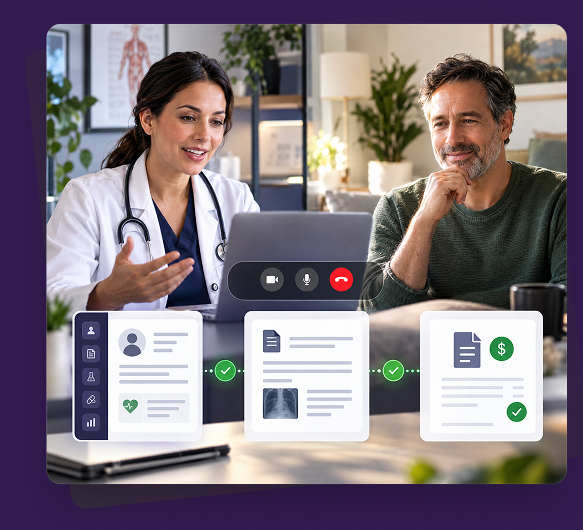
Adopting telehealth should not mean adopting a second system. In Elixir the virtual visit is scheduled on the same calendar, documented in the same chart and billed from the same record as everything else you do.

Clinician on a video visit with a patient, with the chart and claim shown alongside
  1. Pillar 01

    One record, not two systems

    Schedule, chart and claim in the same place. No exporting a visit list from a video tool and matching it to the EHR.

  2. Pillar 02

    Billing set from the visit

    Place of service and modifier derived from how the visit actually happened, rather than inferred by a biller a week later.

  3. Pillar 03

    Built for group programs

    Group sessions with per-attendee attendance and documentation — how IOP and other group-based programs really run.

  4. Pillar 04

    Rules tracked for you

    Telehealth policy has three separate cliff dates in the next 26 months. We track them; this page names them.

Engagement

How Telehealth Improves Patient Engagement

The gains from telehealth are not evenly distributed. They are largest for the patients who were hardest to get into a room — and that is a group most practices have simply written off as unreliable.

  • GRID-REF: ENG-01

    Care reaches patients wherever they live

    Accessibility for everyone irrespective of place of residence, which matters most in rural catchments and for patients without reliable transport.

  • GRID-REF: ENG-02

    Travel time and the stress around it removed

    A 30-minute appointment stops costing half a working day. For hourly-paid patients that is the whole reason attendance improves.

  • GRID-REF: ENG-03

    Unnecessary physical contact minimized

    Routine follow-up, medication review and check-ins handled online, reserving the room for visits that need one.

  • GRID-REF: ENG-04

    On-demand visits scheduled in minutes

    Patients book a virtual slot themselves rather than waiting for a call back, which converts intent into an appointment while it still exists.

  • GRID-REF: ENG-05

    Fewer missed appointments

    Removing the journey removes the most common practical reason people miss care. Where outreach capacity is finite, risk-ranked prediction decides who to call.

  • GRID-REF: ENG-06

    The record does not fork

    Virtual and in-person visits on one chart, so a patient alternating between them has one history rather than two partial ones.

Data

Seamless Patient Data Collection Before and During the Visit

A virtual visit that starts with fifteen minutes of form-filling is a worse experience than the one it replaced.

Unified clinical ingestion

All biometrics, patient-reported outcome measures, and virtual chat transcripts stream directly into the active timeline without duplicate manual transcription.

PHASE-01 // PRE-ENCOUNTER

Structured form intake

Before the visit.

Intake forms, consents, questionnaires and outcome measures completed on the patient’s own device ahead of time, landing in the chart as structured data rather than as an attachment somebody re-types.

PHASE-02 // IN-TRANSIT

Single-window EHR

During the visit.

In-visit documentation in the same window as the call, so the clinician is not alt-tabbing between a video tool and a chart — which is where eye contact and half the clinical detail get lost.

PHASE-03 // POST-VISIT

Single origin claim

After the visit.

The note, the orders, the follow-up appointment and the claim all originate from the same encounter record. Nothing is re-entered, so nothing diverges.

PHASE-04 // ATTESTATION

Jurisdiction capture

Consent captured properly.

Telehealth consent, recording consent where you record, and the state in which the patient was physically located — recorded at the visit, because reconstructing it later is not possible.

Experience

A Personalized Experience for Patients

Virtual care is often accused of being impersonal. That is a property of how it is run, not of the medium.

  • MOD-EXP // 01

    Nurtured at every touchpoint

    Reminders, follow-up and check-ins driven from the record, so contact reflects what happened at the last visit.

  • MOD-EXP // 02

    No physical barriers

    Patients cared for without travel, childcare or time off entering the decision about whether to attend.

  • MOD-EXP // 03

    On-demand virtual visits

    Self-scheduled in minutes through the Patient Portal, at times a clinic room could not offer.

  • MOD-EXP // 04

    Join without installing anything

    A link on the device the patient already has. A required download before a first appointment costs attendance.

  • MOD-EXP // 05

    Preferences that persist

    Language, contact channel and modality held on the record, so the patient is not asked to re-state them every time.

  • MOD-EXP // 06

    Interpreters supported

    Third-party interpreters joined into the visit, with the need flagged before the call rather than discovered during it.

Operations

Higher Staff Productivity With In-Visit Workflows

The productivity gain in telehealth comes from the work around the visit, not the visit itself.

Native Salesforce ecosystem

Direct integration with claims adjudication, patient ledgers, and staff assignment without building or maintaining middleware.

OPS-FLOW // DISTRIBUTED

Staff work remotely too.

Scheduling, intake, eligibility, documentation review and billing all run from wherever your team is, which is what makes a distributed or part-time workforce practical.

OPS-FLOW // MID-CALL ACCESS

Custom in-visit features.

The things a clinician needs mid-call — templates, orders, the previous note, the outcome measure just completed — available in the visit rather than after it.

OPS-FLOW // AUTOMATION

Custom workflows for in-house processes.

The administrative sequences around a virtual visit configured once and then run automatically, rather than depending on someone remembering the order.

OPS-FLOW // INTEGRATION

Additional integrations on Salesforce.

Because the platform is Salesforce-native, the other tools your practice runs connect without custom development.

Billing

Telehealth Billing: Place of Service, Modifiers and What Actually Gets Paid

This is where telehealth revenue is quietly lost, and where most vendor documentation is out of date. Two details are worth more than the rest of this section combined.

Detail onePARAM: POS_RATE_DIFFERENTIAL

Place of service changes what you are paid

POS 10 means the patient was at home, and Medicare pays the higher non-facility rate. POS 02 means the patient was somewhere other than home, which pays the facility rate because that site may bill its own originating-site fee. Coding the wrong one is not a compliance footnote — it is a pay cut. Source 1.

  • POS 10 (Home)Non-Facility Rate
  • POS 02 (Other)Facility Rate
Detail twoPARAM: ORIGINATING_FEE

The originating-site fee has a 2026 figure

Where an originating site can bill the facility fee, HCPCS Q3014 is set at $31.85 for CY2026. Small, but it is per visit and it goes uncollected constantly. Source 2.

HCPCS CODE Q3014 (CY2026 RATE)$31.85 / visit

Current Medicare telehealth modifiers. Sources 1 and 3.

Effective CY2026
ModifierWhat it signalsWhen it applies
95Synchronous telemedicine via real-time audio and videoInstitutional and hospital claims, and where the practitioner is at a hospital and the patient at home.
93Synchronous telemedicine via real-time audio-onlyAppended to the corresponding E/M code. The old telephone E/M codes 99441–99443 are no longer valid.
FQService furnished using audio-only technologyRequired on audio-only behavioral and mental health telehealth, and by FQHCs and RHCs billing audio-only.
FRSupervising practitioner present by real-time two-way audio/videoWhere virtual direct supervision applies — expanded in the CY2026 fee schedule.
GTOutdatedVia interactive audio and videoNo longer the general Medicare telehealth modifier. It now survives essentially only for distant-site practitioners billing under the critical access hospital optional payment Method II. Documentation still telling you to append GT to ordinary telehealth claims has not been updated in years.

One more worth knowing: CMS declined to add the telemedicine evaluation and management code family 98000-98015 to the Medicare Telehealth Services List for CY2026. They remain CPT codes and commercial payers may treat them differently, but do not plan Medicare revenue around them. Source 2.

Medicare policy

Medicare Telehealth Rules and the 31 December 2027 Cliff

Telehealth policy currently has three separate expiry dates inside the next twenty-six months, and they do not move together. Any practice with meaningful virtual volume should know all three.

  1. Now – 2027Status: Active

    Through 31 December 2027, the broad flexibilities hold

    No geographic restriction, any site including the patient’s home qualifies as an originating site, and audio-only is permitted for non-behavioral services.

  2. 1 Jan 2028Cliff event 01

    Pre-pandemic limits return for non-behavioral services

    The patient must generally be in a qualifying rural or shortage area at an authorized originating site rather than at home, and audio-only stops qualifying. If a material share of your Medicare volume is non-behavioral telehealth, model this now.

  3. 1 Jan 2028Cliff event 02

    The tele-mental health in-person requirement begins

    Waived through 31 December 2027. From 2028 a new patient needs an in-person visit within the six months before their first mental health telehealth service, then within 12 months of each subsequent one. Elixir tracks the interval so you are ready — it does not enforce a rule that is not yet in force.

  4. PermanentStatute codified

    Behavioral health keeps the core flexibilities

    Home as originating site, no geographic restriction and audio-only are permanent for behavioral and mental health services — and only for those. Conflating this with general outpatient telehealth is the single most common error in this category. See Behavioral Health.

  5. CY2026Recent revision

    What already changed this year

    The provisional versus permanent distinction on the Medicare Telehealth Services List has been eliminated, frequency limits are permanently removed for subsequent inpatient and nursing facility visits and critical care consultations, direct supervision may now be met by real-time audio and video, and teaching physician virtual presence is permanent.

Sources 2 and 4. Verified September 2026 — confirm before planning against these dates.REF: CMS-RULE-CY26/27

Prescribing

Prescribing Controlled Substances by Telemedicine

This is the nearest and least settled deadline in telehealth, and it is three months away.

Imminent transition

Prescription Drug Monitoring Program (PDMP) checks must be executed directly prior to initiating Schedule III–V e-prescriptions.

DEADLINE STATUS: 31 DEC 2026 EXTENSION

The DEA flexibilities that permit prescribing controlled substances by telemedicine without a prior in-person examination currently run only to 31 December 2026. They have been extended four times. A fifth extension or a final rule is plausible but neither has been issued, and the proposed Special Registration for Telemedicine rule is not final.

21 CFR §1306.51 // OUD CODIFIED PROVISIONS

Separately and more durably, the rule permitting telemedicine prescribing of Schedule III–V medications for opioid use disorder is in the Code of Federal Regulations. It permits audio-only, requires the prescriber to be authorized for the applicable prescription drug monitoring program and to review the patient’s last twelve months of controlled substance data, and supports up to six calendar months from the first telemedicine prescription before an in-person or otherwise qualifying evaluation is needed.

ELIXIR AUDIT TRAIL // NATIVE INGESTION

Elixir supports the PDMP review step inside the prescribing workflow rather than as a separate lookup. What we will not do is tell you this area is settled, because it is not. Sources 5–6.

Licensure

State Licensure and Interstate Compacts: Enacted Is Not the Same as Usable

Telehealth is regulated by where the patient is, not where the clinician is. The licensure compacts are supposed to make multi-state practice workable — but several have been enacted in dozens of states while issuing precisely nothing. A hiring or expansion plan built on an enacted count is built on a number that does not yet mean anything.

As of September 2026. These figures move monthly — four of the seven changed status in the three months before this page was written. Verify against each compact’s own site before making a decision. Sources 7–8.

REPORT: 2026-SEP-REV
CompactEnactedActually issuingUsable now?
Nurse Licensure Compact (RN, LPN/LVN)43 jurisdictions~41 fully implementedYes
PSYPACT (Psychology)~4341 effectiveYes
Interstate Medical Licensure Compact (Physicians)44 states + 2 territories~40 jurisdictionsYes
Counseling Compact (LPC, LPCC, LMHC)38 states + DC9 statesPartly
PA Licensure Compact (Physician assistants)29 statesNone — early 2027 projectedNot yet
Social Work Licensure Compact (LCSW, LMSW)35 statesNone — spring 2027 at the earliestNot yet
APRN Compact (NP, CRNA, CNM, CNS)A handful of statesNot activated — needs seven statesNot yet

Critical compliance notice

Three things to get right before you plan around this

  • The Interstate Medical Licensure Compact is not a multistate license. It is an expedited route to separate full licenses in each member state. Anyone describing it as “one license for 44 states” has misunderstood it.
  • The Counseling Compact is the sharpest gap. Thirty-nine jurisdictions have enacted it; nine are issuing privileges. If your plan assumes counselors can practice across all thirty-nine today, it is wrong by thirty states.
  • Do not plan on the social work or PA compacts at all yet. Both are enacted widely and issuing nothing, with 2027 projections that have already slipped once.

Elixir records the state in which the patient was physically located at the time of the visit, and the credential under which the clinician saw them, because that pairing is what a licensure question actually turns on — and it cannot be reconstructed from a calendar entry afterwards.

Privacy

HIPAA, Audio-Only and Privacy in a Virtual Visit

The COVID-era latitude that let practices run visits on consumer video tools is gone, and has been for three years. A surprising number of practices have not revisited what they set up in 2020.

  • REF // SEC-01OCR POST-PHE

    The date

    Enforcement discretion ended 9 August 2023

    The OCR notification of enforcement discretion for telehealth expired with the public health emergency on 11 May 2023, followed by a 90-day transition period that closed on 9 August 2023. Vendor pages citing “May 2023” are skipping the transition; either way, none of it is still in force. Source 9.

  • REF // SEC-02Contractual

    The requirement

    A business associate agreement is not optional

    Telehealth services must comply with the HIPAA Rules, and covered entities must use vendors that do and execute a BAA with them. We sign one. A platform that will not is not a candidate. Source 10.

  • REF // SEC-03Comm protocol

    Audio-only

    The rules differ by technology, not by the word “phone”

    A traditional landline call is not electronic media, so the Security Rule does not reach it. VoIP, smartphone apps and internet-based systems do trigger Security Rule safeguards — and any platform that records or stores the session is handling PHI and needs a BAA. Source 11.

  • REF // SEC-04Authentication

    Identity

    Verify who you are talking to

    Reasonable safeguards and patient identity verification apply to a virtual visit exactly as they do to one in a room, and the verification belongs in the record.

  • REF // SEC-05Accessibility

    Language

    Meaningful access applies to virtual visits

    Interpreter obligations do not relax because a visit is remote. Interpreter need is flagged before the call rather than discovered on it.

  • REF // SEC-06Risk allocation

    Shared

    Compliance remains shared

    The platform supplies the controls and the audit trail. Your risk analysis, policies and workforce training stay with you. No software makes an organization HIPAA compliant.

Why Elixir

Why Choose Elixir for Telehealth

Elixir’s telehealth runs inside the EHR and billing platform rather than alongside them, which is what makes the rest of this list possible.

  • Capability 01

    Fewer barriers to attendance

    Removing the journey removes the most common practical reason patients miss care — particularly the patients hardest to reach.

  • Capability 02

    Flexible scheduling

    Patients and staff schedule telehealth consultations on the same calendar as everything else, including out-of-hours slots a clinic room cannot offer.

  • Capability 03

    Minimal onboarding time

    Patients onboarded without the delay of multiple in-person visits to complete intake.

  • Capability 04

    Increased patient satisfaction

    Access to the services patients want without physical boundaries deciding whether they get them.

  • Capability 05

    Custom workflows

    Administrative sequences maintained without additional staff, so clinical time stays clinical.

  • Capability 06

    Fewer no-shows

    Flexible scheduling and consultation from anywhere remove two of the biggest causes of a missed appointment.

  • Capability 07

    Easy payment collection

    Payment details captured and collected as part of the visit rather than chased afterwards.

  • Capability 08

    Streamlined communication

    Patients reached through their preferred channel, with the whole journey on one record.

Questions

Telehealth Software: Frequently Asked Questions

What practice leaders, billers and compliance staff ask us first.

  1. Is Elixir telehealth a separate product from the EHR?

    No. Telehealth runs as a native feature inside the Elixir platform. Virtual visits appear on the same scheduling grid, link to the same patient chart and generate claims into the same billing workflow as in-person visits.

  2. What do we bill for a telehealth visit?

    Telehealth visits use the standard CPT evaluation and management or therapy codes, distinguished by place of service and modifier. For Medicare, POS 10 indicates the patient was at home (paying non-facility rates) while POS 02 indicates another site. Modifiers signal whether the visit was audio-video (modifier 95 on hospital/institutional claims) or audio-only (modifier 93 or FQ). Commercial payers establish their own POS and modifier rules, which Elixir maps by payer.

  3. Is modifier GT still used for Medicare telehealth?

    Essentially no. For Medicare fee-for-service, modifier GT has been deprecated for general telehealth claims for several years and now survives almost exclusively for distant-site practitioners billing under critical access hospital optional payment Method II. Documentation advising you to append GT to ordinary telehealth claims is out of date.

  4. Can we treat patients in other states?

    Only where the clinician is licensed in the state where the patient is physically located at the time of the visit, or holds active privileges through an interstate compact that is actually issuing them (such as the IMLC, PSYPACT or the Nurse Licensure Compact). Several enacted compacts — notably the Counseling, Social Work and PA compacts — are not yet issuing privileges in all member states.

  1. Do the Medicare telehealth rules change soon?

    Yes. Broad flexibilities (including home as originating site and audio-only for general services) run through 31 December 2027. On 1 January 2028, geographic and site restrictions return for non-behavioral services, and the six-month in-person requirement for mental health telehealth begins. Behavioral health keeps home-as-originating-site permanently. DEA prescribing flexibilities currently expire earlier, on 31 December 2026.

  2. Does Elixir support group telehealth sessions?

    Yes. Group sessions support multiple participants with individual attendance tracking, per-patient clinical documentation and independent claim generation, designed for intensive outpatient programs (IOP) and group therapy.

  3. Is the platform HIPAA compliant?

    Elixir provides the technical, physical and administrative safeguards required under the HIPAA Security Rule, and we execute a Business Associate Agreement with every covered entity customer. The enforcement discretion that permitted consumer video tools during the pandemic ended on 9 August 2023.

  4. Can patients join without installing anything?

    Yes. Visits run in standard modern web browsers on smartphones, tablets and desktop computers. Patients join through a secure link sent by SMS or email or from within the Patient Portal, with no app download required.

One system, not two

See a virtual visit from schedule to claim

Bring your payer mix, your states and your visit types. We will show you the same patient scheduled, seen, documented and billed — without leaving the record once.